

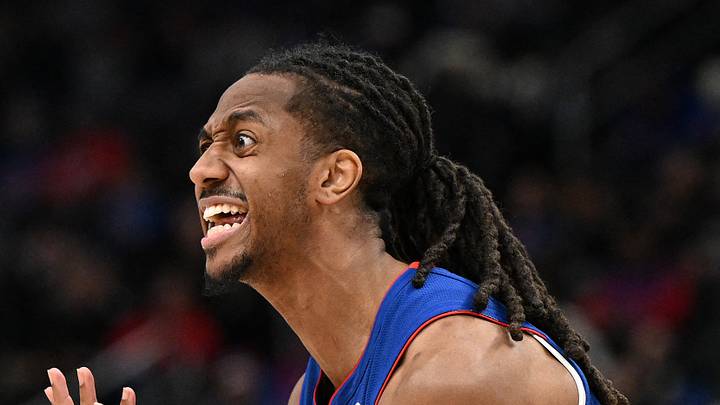
Daniss Jenkins was one of the best stories in the NBA last season, going from a two-way contract to a guy who was starting for a 60-win team in the playoffs.
Jenkins got his opportunity because of early injuries, but he made the most of it, which allowed the Pistons to trade Jaden Ivey while he still had some kind of value.
Daniss will have an even bigger opportunity next season, but also more competition, so he’ll have to be more than just a nice story if he wants to keep his spot in the rotation.
Daniss Jenkins has to get better around the rim
Jenkins was a reliable ballhandler for most of last season, and showed he can run the offense, though he did have the propensity to dribble the life out of the ball at times, something he’ll have to clean up.
He was also good off the ball, which allowed him to play with Cade Cunningham and get another ball handler on the floor. Jenkins shot nearly 38 percent from 3-point range, including over 45 percent on catch-and-shoot 3’s, which was second on the team to Marcus Sasser.
His continued development as a 3-point shooter will certainly benefit his dribble creation, as teams will have to close out harder.
The problem is that Jenkins shot just 40 percent overall and was absolutely terrible around the rim. In fact, Jenkins had the worst drive field goal percentage in the NBA last season at just 31.3 percent.
Jenkins only hit half of his layups and was just 30 percent on shots between 5-9 feet, which is an area he will have to improve if he wants to be the primary backup point guard.
Jenkins has proven that he can get to the rim, but he has to start finishing those shots for it to matter.
Daniss Jenkins will have competition from Ebuka Okorie
Jenkins played well last season, but he really won the position by default, as Ivey got hurt again, and Detroit didn't have anyone else.
To his credit, Jenkins seized the day, but he’ll have more competition next season from rookie Ebuka Okorie, who showed a clever bag around the rim on his way to being one of the top scorers in college basketball last season.
Okorie shot nearly 47 percent from the floor last season and was closer to 60 percent on shots right around the rim. Okorie was also eight percent better than Jenkins on short mid-range shots and 12 percent better from 10-14 feet, and that was with much higher usage, and the entire defense of the other team focused on stopping him.
But that was also in college, and Okorie’s Summer League run showed he needs to put on strength to adjust to the NBA. He’s not going to take Jenkins’ spot right away, but being a better finisher in the paint will speed up the process.
It’s still Daniss Jenkins’ job to lose, but he has to find ways to convert more of his drives and shots around the rim and in the lane.
 Add us as a preferred source on Google