

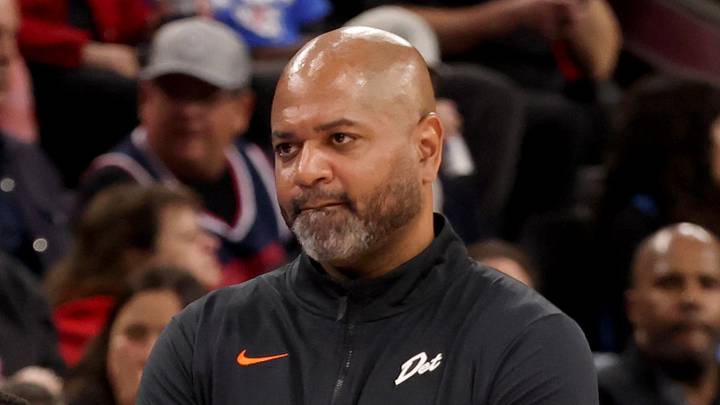
After losing two games in a row, head coach JB Bickerstaff decided to make a change to the starting five, promoting red-hot guard Daniss Jenkins and putting Paul Reed on the bench.
This left John Collins as the starting center, which was a bold move from Bickerstaff, as Collins had been struggling. It was a calculated gamble to help break him out of his slump, and hopefully get the Pistons’ offense moving, as they’d had some stagnant stretches in their previous two games.
The Pistons were starting to slip into some bad habits (relying on the Cade Cunningham PnR too much) and the starting lineup wasn’t moving the ball, so coach Bickerstaff supercharged it with another guard.
The Pistons won the game, so obviously it worked, and there were some positive signs from the offense, but there was also the trade off, which the Pistons won’t get away with in most games.
The Pistons were fast, but couldn’t stop Anthony Davis
Anthony Davis has had some monster games against the Pistons and will forever hold the scoring record at the Palace of Auburn Hills. He nearly broke the LCA record as well, as Davis put up 30 points in the first half, and the Pistons did little to stop him.
Luckily for Detroit, no one else on the Wizards showed up, so they were able to eventually run away with it behind their depth, as the Washington bench scored just 10 points combined, a number that Kevin Huerter eclipsed by himself with 12 points.
Detroit couldn’t stop Davis in the paint and were outrebounded on the night, which has become far too common with Jalen Duren still out with injury.
The tradeoff was that the Pistons played fast all night and took care of the ball. They were able to turn the Wizards over 19 times, and when they did, they got out and ran. The Pistons finished the night with 19 fast break points to just four for the Wizards, which was the difference in the game.
Going small left the Pistons vulnerable to a big night from Davis, but it also allowed them to play fast, and kept them out of half court sets, which is where Detroit often struggles.
The Pistons’ advantage in quickness also allowed them to pick up fouls and get to the line for 31 free-throw attempts, and unlike the game before, the Pistons actually made them.
Going small with John Collins injected some speed and life into the offense, but there was a flip side, which was the Pistons were small, lost the battle of the boards and gave up 44 points to Anthony Davis.
Small ball can be a weapon, but it will be much better when used in small bursts to mitigate the negative side.
 Add us as a preferred source on Google