

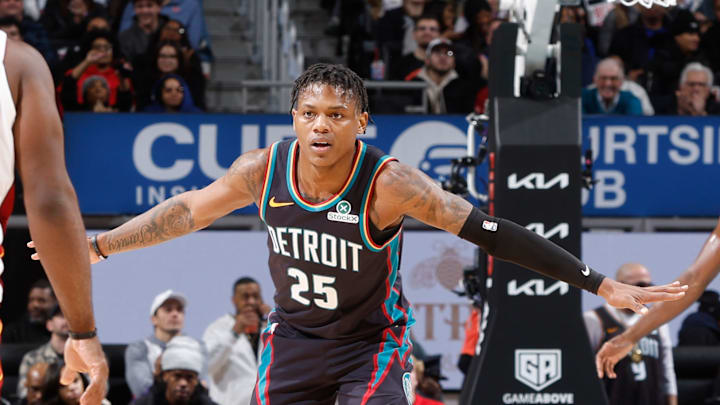
The Detroit Pistons have remained confident that Marcus Sasser can realize his potential. Injuries unfortunately robbed him of 25 games in 2024-25 and 28 in 2025-26, but he's proven when healthy that his talent is worth investing in.
With Sasser rounding into form upon his return from injury in 2025-26, the Pistons can begin to feel validated for betting on him as a better long-term option than Dennis Schröder.
Detroit acquired Schröder ahead of the 2025 NBA trade deadline and immediately benefited from his presence. The Pistons went 17-11 in the 28 regular season games he played, with the veteran providing invaluable balance to the rotation as a scorer and playmaker.
Schröder left Detroit to join the Sacramento Kings over the summer, however, on a three-year, $44.4 million salary the Pistons could've realistically afforded to pay him.
It was a risky decision considering how well Schröder played for Detroit and how desperately they needed to alleviate pressure from Cade Cunningham. It looked like an even more questionable decision when both Jaden Ivey and Sasser missed considerable time to start the 2025-26 season.
With Sasser back in the rotation and beginning to look like the player the Pistons believe he can be, however, the decision to opt against re-signing Schröder is paying off.
Marcus Sasser justifying Pistons moving on from Dennis Schröder
Sasser encountered early struggles when he made his 2025-26 season debut in early December. He went scoreless in three of his first four games, albeit while playing limited minutes. After a brief four-game absence, however, he's seemingly righted the ship.
Sasser bounced back with 19 points, five assists, two rebounds, and two steals in just 24 minutes during the Pistons' Dec. 30 win over the Los Angeles Lakers.
Sasser started the new year in style by following his standout showing with another impressive performance. He tallied 18 points, four rebounds, two assists, and two steals in 24 minutes during the Pistons' seven-point loss to the Miami Heat on Jan. 1.
With 37 points and eight three-point field goals made between his past two appearances, Sasser is addressing the Pistons' glaring need for shooting in an explosive manner.
Pistons fans aren't exactly surprised by Sasser stepping up and producing eye-opening numbers. He's consistently maximized his opportunities from a statistical perspective, posting averages that had many calling for an uptick in playing time.
The third-year guard boasts career averages that translate to 16.2 points, 6.2 assists, 2.8 rebounds, 1.4 steals, and 2.5 three-point field goals made per 36 minutes on .445/.386/.871 shooting.
The hope in Detroit is that Sasser can begin to produce those type of numbers on more of a nightly basis. In the event that he stays around the 24 minutes per game he's played in recent days, it's plausible that he could succeed in at least coming close.
Regardless of what Sasser's production looks like, the Pistons' gamble on his upside being a more significant asset than Schröder's veteran tendencies is in the early stages of paying off.
 Add us as a preferred source on Google