

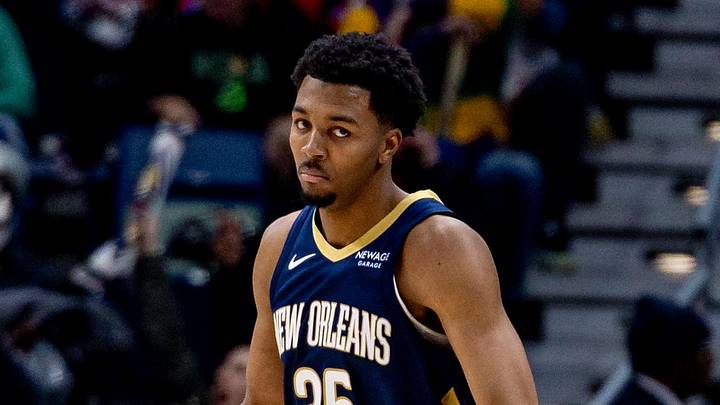
The Detroit Pistons are reportedly interested in Los Angeles Lakers shooting guard Austin Reaves and New Orleans Pelicans wing Trey Murphy III. Though there is perhaps a path to acquiring both, the odds are in favor of Detroit ultimately having to prioritize one over the other.
If the need to choose between them ultimately comes to pass and the Pistons have the luxury of both rising stars being attainable, then the choice would be simple: Murphy over Reaves.
Dan Woike of The Athletic reported on Jun. 12 that the Pistons are interested in signing Reaves. The polarizing element of that pursuit is that they'll need to compete with the Brooklyn Nets' planned four-year, $178.5 million offer for the 28-year-old offensive dynamo.
Detroit will also be bidding against Los Angeles, of course, as the purple and gold have a known interest in re-signing Reaves.
Murphy, meanwhile, would be acquired by different means. Marc Stein of The Stein Line reported on the same day that Detroit is among the teams that have expressed interest in trading for the 25-year-old sharpshooter. The hurdle in doing so, however, is that New Orleans wants, "A lot," in a potential trade.
Though the Pistons may have to give up quite a bit in a trade for Murphy, history has rewarded the teams that are willing to gamble.
Trey Murphy III is a safer gamble for the Pistons—even with a steep cost
When the Orlando Magic acquired Desmond Bane from the Memphis Grizzlies, they shipped out four first-round draft picks and a pick swap. When the New York Knicks traded for Mikal Bridges, they gave up four unprotected first-round picks, a pick swap, a protected first-rounder, and a second-round selection.
Murphy compares favorably to Bane and Bridges in terms of pre-trade production and market value, which suggests the Pistons will need to make a similar offer. They shouldn't be afraid to do so.
First-round draft picks are undeniably valuable, particularly due to how they enable teams to build out their rotations with affordabale talent. The Pistons already have a young core in place, however, with Cade Cunningham, Jalen Duren, Isaiah Stewart, and Ausar Thompson all 25 or younger.
Murphy, who's 25 himself, would fit right in with their timeline of development and offer the type of value the Pistons could only dream of any one of the picks they'd lose providing.
Moreover, Detroit isn't a young player away from reaching the Conference Finals. They need proven talent that can step into a meaningful role and help raise the ceiling of a team that already won 60 games with questionable shot creation depth.
That's where Murphy and Reaves both slot in, but the difference between them is the remaining cap space that could be utilized elsewhere for instant impact players.
Pistons can navigate trading picks easier than a monster salary
The fear of what losing picks might entail is rational, but the most crucial bit of context is as clear as day: Detroit is already in the very position fans may be afraid of seeing them unable to enter. And it isn't working out particularly well for them.
The Pistons simply have less of a need for drafted talent who need time to develop than proven veterans who are ready to support a proven core.
As such, while acquiring Murphy would require losing draft picks, he'll make $87 million over the next three seasons—compared to Reaves potentially making more than $120 million during that time. Even if Reaves were to sign for $40 million per season—which appears to be lower than he will if Woike's report proves true—the Pistons would save an average of $11 million per season by prioritizing Murphy.
The financial stability achieved from trading for Murphy could permit the Pistons to continue making moves in free agency, with a young core already in place to build around. Steep as the cost may be, that's Detroit's best path forward between these two options.
 Add us as a preferred source on Google