

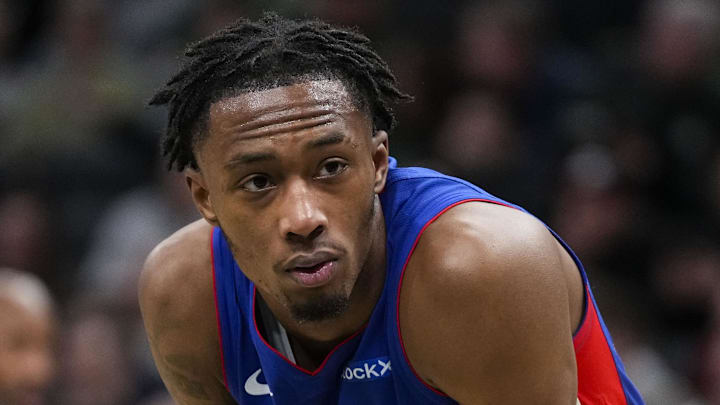
The Detroit Pistons' credentials as NBA contenders are both obvious and absolute—even if experts don't always agree with them. No team wins 76 percent of its games and posts the league's second-highest net efficiency rating by accident.
Even if this ascension is way ahead of schedule, it's still happening. It should be thoroughly enjoyed, obviously, but it should also raise expectations to the point when they're on par with the over haves of the hoops world. Of course, that also ups the difficulty level to a nearly impossible degree, meaning Detroit might have to do everything in its power to maximize its strengths and minimize its weaknesses.
Even if that means switching up the pecking order come playoff time by sitting prized prospect Ron Holland II for veteran journeyman Javonte Green. Because once the postseason game-planning starts, Holland's long-term standing with the franchise means a lot less than Green's superior three-ball and the ability to stick on the floor that comes with it.
"I'm interested to see if they just, like, fully trust [Green]—they play him more than Ron Holland a lot of games—does J.B. [Bickerstaff] end up trusting him more than Ron is a real question to me, as well," The Athletic's Sam Vecenie said on the Game Theory Podcast. "I will be very interested to see how they handle the Javonte-Ron Holland mix in the playoffs."
Holland vs. Green will be a real debate for Detroit.
If there was a concern about the Pistons that didn't involve their collective lack of playoff experience, it would come back to the offensive end and almost certainly reside on the perimeter.
Because that's one of the only places where the Pistons look pedestrian. They dominate on defense, they live at the foul line, they crash the glass, and they consistently convert turnovers into points. But they don't take many threes (27th in attempts), nor make them at a convincing clip (19th in percentage).
What does that have to do with the Holland-vs.-Green discussion? Everything, honestly. Both are stingy, relentless, disruptive defenders, so Detroit has to look at the opposite end for separation between them. And while Holland has the deeper bag, that doesn't matter much in the support role they'd be filling.
In that gig, it's all about spacing the floor and converting open shots as they come. That's where Green could get the nod. While he's certainly no not-shredder (career 34.4 percent on forgettable volume), he has at least shown a level of competence that has so far eluded Holland (career 23.5 percent).
Playoff defenses will certainly try to force either one to shoot. In terms of process, getting the ball away from MVP candidate Cade Cunningham and into the hands of one of these defense-first contributors on a catch-and-shoot situation would be a win.
But Green can actually make enough of those shots to perhaps not be a total space-killer (36.6 percent on catch-and-shoot threes, per NBA.com). Holland just doesn't have the touch to do the same (24.2 percent).
It's entirely possible the Pistons are willing to live with Holland's limitations and play him over Green anyway. And it could be the correct call, since Holland has had the better net rating differential (plus-1.1 points per 100 possessions to Green's minus-3.0).
But it's definitely something for Bickerstaff and his fellow decision-makers to think about. Because the Pistons are good enough to go in full-pursuit of their greatest goals, and you'd hate to see the plan fall apart amid a barrage of bricks.
 Add us as a preferred source on Google