

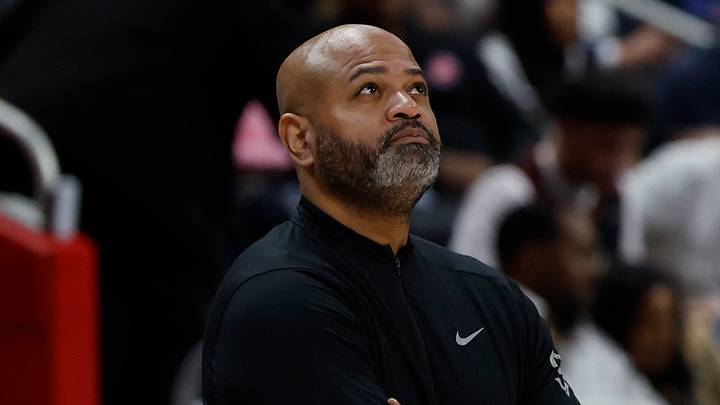
The Detroit Pistons are on pace to enter the 2026-27 season with the same issue as they had in 2025-26: A lack of shot creation depth. That's put head coach J.B. Bickerstaff in a less than ideal position as he faces the tall task of finding creative solutions to avoid potentially overburdening franchise player Cade Cunningham—again.
Cunningham is one of the best players in the NBA, but if the Pistons are going to realize their potential, then they'll need to simplify the game for him in 2026-27. The question is: How can they do so with limited personnel?
The ideal outcome would be for Jalen Duren to re-sign and thus reunite with Cunningham for at least one more season. In that scenario, the Pistons would have two All-NBA players who are capable of creating offense in a system that revolves around their high-low balance.
Even with Duren in the fold, however, Detroit's lack of playmakers and shot creators along the perimeter has put Cunningham in a difficult spot.
In 2025-26, Cunningham and Duren were the only Pistons who averaged more than 13.3 points per game. Cunningham was the only player over 3.9 assists per contest. Furthermore, Cunningham and Daniss Jenkins were the only two players who averaged at least 6.0 drives per game—and Jenkins shot 38.5 percent in said scenarios.
Detroit has made on-paper improvements to its shooting and arguably its forward play, but Bickerstaff will need to change elements of the Pistons' approach to adequately support Cunningham.
Pistons' lack of shot creators means Cade Cunningham needs unique help
One manner in which the Pistons can make the game easier for Cunningham is to turn the influx of shooters into a greater emphasis on three-point shooting. In 2025-26, Detroit ranked No. 29 in the NBA in three-point field goals attempted.
It was an admittedly justifiable approach due to the lack of reliable three-point shooters, but John Collins, Isaiah Joe, and Taurean Prince are all newcomers who shot at least 40.6 percent from beyond the arc last season.
Another adjustment the Pistons can make is to feature Paul Reed more on offense. Reed played just 13.9 minutes per game in 2025-26, but after trading Isaiah Stewart, a void exists at backup center. Reed is ideally suited to fill it as a high-volume scorer who averaged 20.1 points per 36 minutes last season.
Along those same lines, Collins has averaged as many as 21.6 points per game and checked in at 19.0 on .527/.399/.848 shooting as recently as 2024-25.
Jenkins' growth as a scorer and Ebuka Okorie turning in a solid rookie season could help, but until that transpires, the Pistons must adapt accordingly. That could ultimately call on Cunningham focusing more on his playmaking than his scoring, or for the Pistons to take an inverted approach that asks him to score more and trust his shooters when he kicks it out.
Regardless of how Bickerstaff resolves the impending issue, he'll need to get creative until internal development is proven to have taken hold.
 Add us as a preferred source on Google